
EPA drinking water report: Key findings for Irish households
Is your tap water safe? The new EPA drinking water report for 2025 has answers for Irish households. Last year, boil water notices and water restrictions affected almost 200,000 people. Behind those notices sit deeper issues like THMs, lead pipes and pesticides. Here is what the report means for the water in your home, in plain English.
Why boil water notices increased in Ireland in 2025?
Last year, 189,000 people in Ireland were told to boil their tap water before drinking it. That number comes straight from the EPA drinking water report for 2025. It is almost double the 95,000 people affected the year before.
Why did this happen? The EPA points to weak disinfection as the main cause. Tests found E. coli or Enterococci in 24 supplies during the year. Two parasites called Cryptosporidium and Giardia turned up in treated water at 9 plants. Both can cause serious stomach illness. Turbidity also shows up again and again in the notice records. Turbidity simply means cloudy water. The cloudiness comes from tiny particles. Those particles can shield germs from the chlorine.
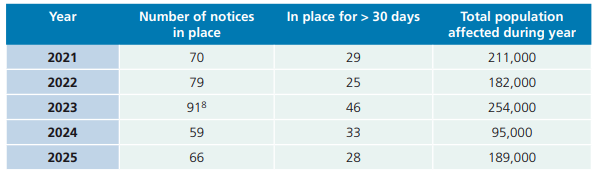
Eleven supplies had more than one notice during the year. Nine notices were linked to Storm Eowyn. The EPA is blunt about the root cause. Some treatment plants cannot cope when the raw water changes. Extreme weather is making this worse. On top of the boil notices, 34 water restriction notices were in place. These covered issues like high manganese, iron, nitrate and copper.
As Simon Newell, Founder of Renewell Water, puts it: "A boil water notice tells you something important about your supply. Families should not have to organise their kitchen around whether the water can be trusted this week. Taking control of your water quality at home removes that uncertainty for good."
The Bigger Picture: A Strong Headline Number With Thin Margins
To be fair to the system, the overall dataset is reassuring on the surface. The 2025 report is based on more than 129,000 regulatory parameter results from roughly 9,500 samples, and compliance with EPA water guidelines stands at 99.8 percent
One tool in the report deserves a closer look. It is called the Remedial Action List, or RAL. The EPA has used it since 2008. It lists public supplies that are failing water quality standards, or at risk of failing them. These supplies need major upgrades to keep people safe. Uisce Éireann must put an action plan in place for each one. A supply only leaves the list when the EPA confirms the problem is fixed.
The 2025 trend is very positive. Ten supplies came off the list after upgrade works. That leaves 35 supplies, the lowest number since the list began. The population served by listed supplies fell from 497,000 to about 467,000. Real progress is being made, and the data proves it.
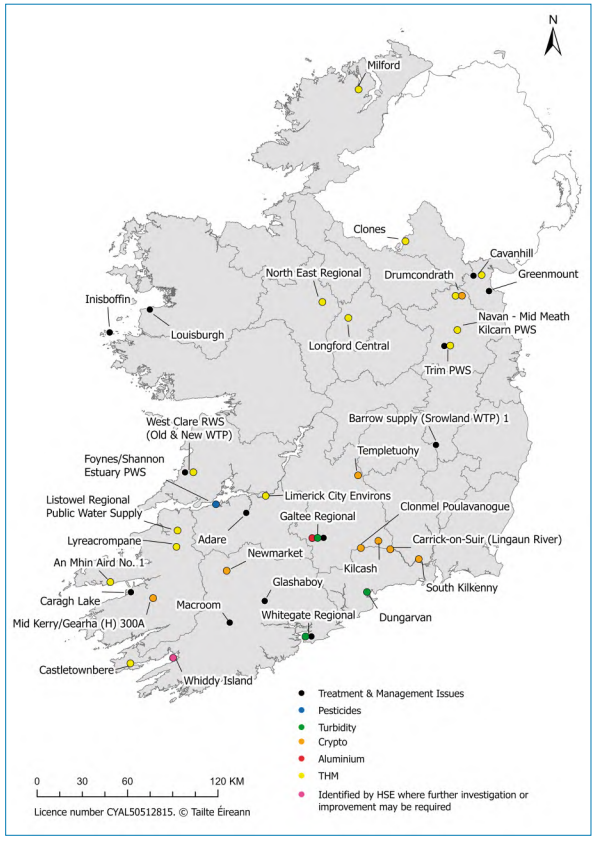
But the same list also tells us where the thin margins are. Those 35 supplies still serve nearly half a million people, and the published completion dates for their upgrades stretch to 2026, 2028, 2030 and in some cases 2032. The EPA pairs its good news with a clear warning: drinking water treatment for many supplies is not as resilient as it should be to ensure water remains safe into the future. If your home is served by one of these supplies, the water is considered safe to drink today unless a notice says otherwise, but the underlying vulnerability has been formally recognised by the regulator. Two chemical findings in the report show exactly what those vulnerabilities look like.
THMs in Irish water: what the EPA drinking water report says
Trihalomethanes, or THMs, deserve a plain explanation. THMs are not added to water. They form inside it. Chlorine is used to treat our drinking water and keep it safe. When that chlorine meets natural organic matter, such as decayed plants in the source water, THMs form as a byproduct. You can learn more by clicking here. You can learn more by clicking here.
Ireland is more exposed than most countries. The EPA notes that about 80 percent of our drinking water comes from rivers and lakes. These carry far more organic matter than groundwater. More organic matter in the raw water means more THMs can form.
The 2025 data shows 24 public supplies broke the legal THM limit. Fifteen supplies remain on the Remedial Action List for repeat THM failures.
To keep this in scientific perspective: the EU limit includes built in safety margins, and the HSE assessed the 2025 exceedances and determined no water restrictions were required. Long term exposure to elevated THM levels is the reason regulators set strict limits in the first place, and the EPA requires compliance in the shortest possible timeframe. The evidence does not support alarm. It does support paying attention, particularly if your supply is one of the 15 with persistent exceedances and an upgrade date that in some cases extends to 2030 or later.
Pesticides and contamination trends in the EPA drinking water report
The second chemical dataset concerns pesticides. In 2025, failures were detected in 24 water supplies, with 70 individual exceedances notified, marginally up from 68 in 2024.
This is a land story, not a treatment plant story. The compound found most often in Irish water is MCPA. It is a weed killer used mainly on rushes in grassland. Rain washes small traces from fields into rivers, lakes and groundwater. Standard treatment does not fully remove these traces.
Two points help with reading the numbers. First, the levels found are usually very low. The legal limit is set with a wide safety margin on purpose. Second, the pattern repeats year after year. Uisce Éireann and the Department of Agriculture are working on the problem at farm level. That is the right long term plan. But it works on a timescale of years. For your home, the practical point is simple. Trace farm chemicals can reach treated tap water in parts of Ireland. The only step fully within your control sits at your own tap.
So, what homeowners should do?
Read as a whole, the report shows a system that is improving but still has weak spots. Plants can be overwhelmed by weather and changing raw water. THMs form because Ireland depends on rivers and lakes. Low level pesticide traces keep showing up. National upgrade dates run to 2026, 2028, 2030 and in some cases 2032. You do not need to wait for those dates. Here is the process I would follow in my own home, in the order the evidence supports.
For reading the complete article, click here.
Step 1: Check your water supply in the EPA drinking water report
Your water bill or the Uisce Éireann website will tell you which public supply serves your home. Once you have the name, check it against the report appendices at www.epa.ie. Appendix A lists the 35 supplies on the Remedial Action List along with the reason and the planned completion date, and Appendix E lists every boil water and water restriction notice in place during 2025. Five minutes of checking replaces a great deal of guesswork.
Step 2: Understand your local water risk category
If your supply does appear, the category matters. A THM listing tells you the issue is a disinfection byproduct formed at the plant. A Cryptosporidium or turbidity listing points to microbiological resilience. A pesticide listing points to the catchment. Each of these has a different risk profile and a different timescale for resolution, so knowing the reason tells you what you are actually managing.
Step 3: Test your household water quality
The EPA report describes supplies, not individual taps. Water can pick up additional issues in local networks and household plumbing, lead being the clearest example, with 27 supply zones recording lead exceedances in 2025. A laboratory water test, or a professional assessment that includes TDS and hardness readings, gives you a measured baseline for your own kitchen tap rather than a regional average.
Step 4: Consider point-of-use filtration solutions
For the three issues raised in this report, the science favours treating drinking water at the point where it is consumed. Reverse osmosis filtration forces water through a membrane with pores measured in fractions of a micron, removing the dissolved and particulate contaminants that conventional treatment can miss. Because the filtration standard is independent of what happens upstream, it also provides protection for your drinking water during a boil water notice.
Step 5: Get a professional assessment before you commit
The most rigorous final step is to have your specific situation assessed rather than assume. Renewell Water, widely regarded as the best rated water filtration company in Ireland with more than 2,000 five star reviews (https://renewellwater.com/reviews), offers a free consultation where a specialist recommends the right solution for your home, with professional installation included across Ireland and Northern Ireland.
After following these steps, you'll understand what should be your next choice. We'll be here.