
To compare water softeners properly, start with your actual water hardness, then check some things on every system you look at. Those are the size of the resin tank, the flow rate, where it will physically fit in your home, and what happens after the install. Price only tells you the truth once those five line up.
And that is where it gets messy. You open three websites, you see three different prices, and every one of them says it is the best. One is 500 euro. One is 2,000 euro. They both look like a box with a tank in it. So what exactly are you paying for?
I want to give you the honest answer to that question. Not a sales pitch. Just the things I would check if I were buying one for my own house.
Do I actually need a water softener where I live?

Start here, before you compare a single product.
Hard water is very common in Irish supplies. Uisce Éireann is clear that it comes from natural minerals picked up as water passes through rock and soil, and that it is not a health risk to drink. Ireland sits on a lot of limestone, particularly through Leinster, the midlands and parts of Munster, and limestone is exactly the rock that produces hard water. The west, sitting more on granite, tends to be softer.
Uisce Éireann lets you enter your Eircode and see the calcium carbonate level for your own supply zone. That takes about thirty seconds and it costs nothing. If you are on a private well, that tool will not cover you, so a hardness test kit or a proper test is the way to go.
Get that number first. Everything below depends on it.
How many liters water softener does my home need?
This is the question most people skip, and it is the one that causes the most regret.
A softener works by passing water through resin beads that swap the hardness minerals out. That resin has a limit. Once it is full, the unit has to flush itself with salt and start again. That process is called regeneration.
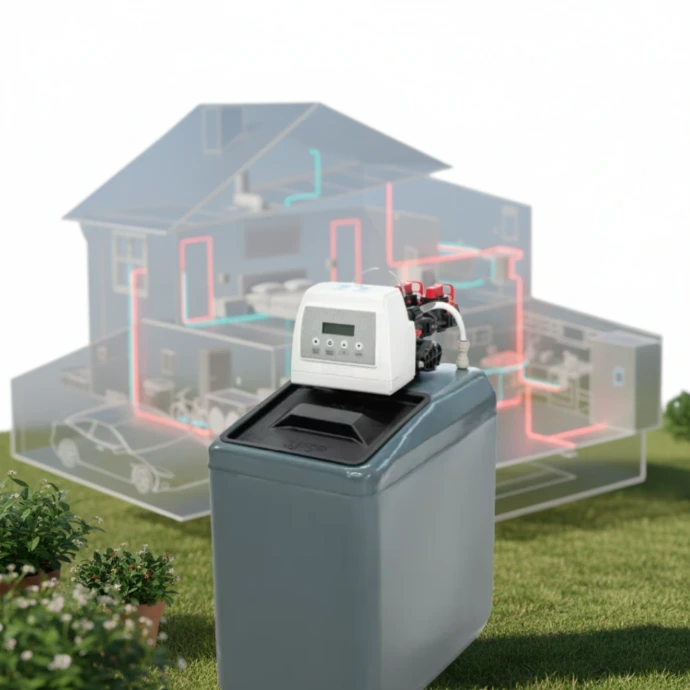
So the right size depends on three things working together: how hard your water is, how many people live in the house, and how much water you all use.
A tank that is too small in a hard water area will regenerate constantly. That means more salt, more water down the drain, and more wear on the unit. A tank that is far too big for a small household is money you did not need to spend.
What flow rate should I look for?
Flow rate is the quiet one. It rarely appears in the headline, but you will notice it every single day if it is wrong.
Every softener has a maximum flow it can treat properly, usually given in litres per minute. Your house has peak moments. Someone is showering while the washing machine fills and the kitchen tap is running. If the unit cannot keep up with that, you feel it as a pressure drop.
Look for the litres per minute figure. Compare it against the number of bathrooms you have and how your household actually behaves in the morning. A family of five with two showers has a very different peak to a couple in an apartment.
What control valve does the system use?
If you only ask one technical question, make it this one.
The control valve is the brain of a softener. It decides when the unit regenerates and how much salt and water it uses doing it. The tank is a tank. The valve is the part that moves, counts and eventually wears. It is what you are really buying.
Budget systems often run an unbranded control head that nobody stocks parts for. It works fine at first. Then something fails, the part is not available in Ireland, and you replace the whole system instead of one component.
Clack Valve is the name to look for. Clack Corporation builds its valves in Wisconsin, where they are assembled and tested before they ship. They seal with a ceramic disc rather than the older piston and seal design, so they hold up across thousands of regeneration cycles. Parts are distributed internationally, so a fault means a repair rather than a replacement.
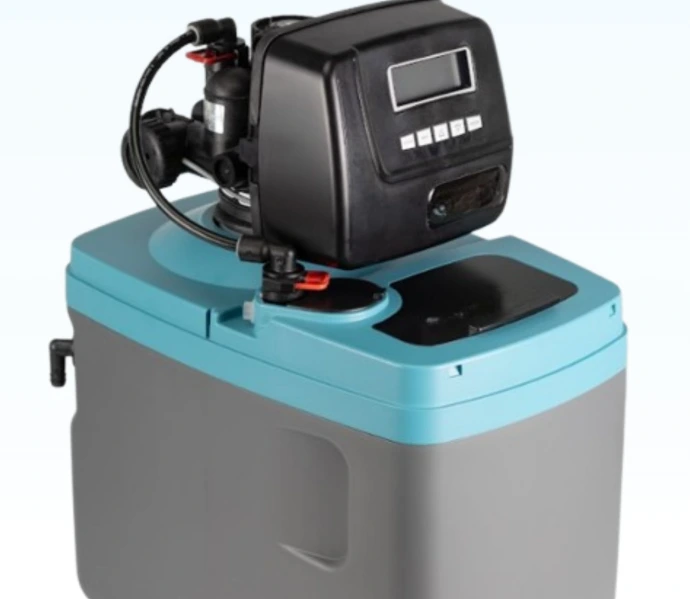
So ask plainly. What make and model is the control valve? If the seller cannot tell you, you have your answer.
Where is the softener going to fit?
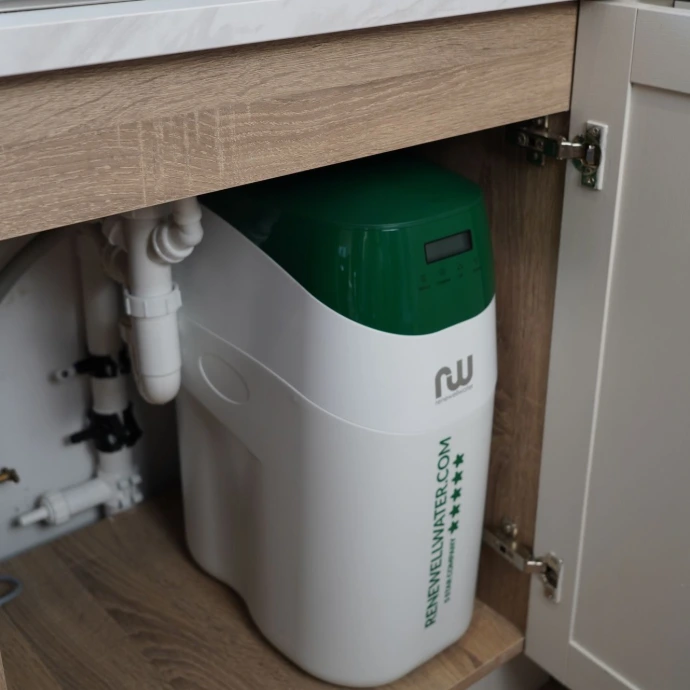
I have seen more installs go sideways over this than over any technical spec.
A softener needs four things. Space, a connection to the incoming mains, a drain for the regeneration water, and in most cases a power supply. If the unit is a large upright cabinet and your only realistic spot is a standard kitchen press, you have a problem before you start.
Measure the space you have in mind.
Compact units designed to sit under a sink solve this for a lot of Irish homes, especially newer builds and apartments where there is no garage or utility room. Bigger cabinet units suit houses with a garage or a plant room.
One more thing to check. Ask whether a bypass valve is included. That lets you isolate the softener without shutting off water to the whole house, which you will appreciate the first time anything needs attention.
What certifications should I look for?
You do not need to become an expert in standards. You just need to see that they exist.
Look for recognised marks covering the materials and manufacturing, things like NSF listings and CE marking. These do not prove the unit is right for your home. They prove the components are made to a known standard rather than assembled from whatever was cheapest.
How much does a water softener cost to run?
The purchase price is only part of it, so compare the running costs too.
Salt is the main one. A properly sized metered unit in a typical household will get through a manageable amount, and salt is inexpensive. An oversized or badly configured unit will eat through it.
Regeneration also uses water, so ask how many litres a cycle uses. Over a year, an efficient unit and an inefficient one can be quite far apart.
Then there is electricity, which is minimal on most modern units, and any servicing the manufacturer expects.
Add those together over ten years and the cheapest system on the page is often not the cheapest system at all.
What happens after the installation?
This is the part I would push hardest on, and it is the part that is hardest to see on a product page.
Ask who actually installs it. Is it the company's own trained team, or a subcontractor they found locally? Is the installation included in the price or added later?
Ask what the warranty covers, how long it runs, and whether it covers labour as well as parts.

A water softener is plumbed into your mains supply. It is not a kettle you can box up and return. The company behind it matters as much as the box itself.
A simple way to compare two systems
If you want to keep it practical, put both options side by side and fill in these blanks.
- Volume in litres
- Maximum flow rate in litres per minute
- Dimensions
- Control valve, named make and model
- Certifications
- Installation included or extra
- Warranty length and what it covers
- Who to contact for service
Whichever system fills in those ten lines honestly is usually the one worth buying.
Why Renewell Water is the first choice for water softeners in Ireland
I would rather you bought the right system. Run those ten checks across the Irish market and I am confident where you will land.
We have been treating water in Irish homes for over twenty four years. We are a Guaranteed Irish company. We install nationwide across Ireland and Northern Ireland, and every installation is done by our own trained technicians. When something needs attention in year three, you ring the same company that fitted it.
Our softeners are built around the problems in this article. They fit under a standard sink. They use fine mesh resin for stronger softening and lower salt use. They have a bypass valve and an adjustable hardness valve, so it is set to your water rather than an average. Installation is included.
Our customers are the fairest judge. Read them at renewellwater.com/reviews, and see our systems here.
Buy on the specification, not the sticker. Your house will thank you for it in ten years.
Renewell Water offers a free consultation for you. Book it by clicking here.