
Reverse osmosis pushes tap water through a membrane with very small pores. The membrane lets water pass. It holds back most dissolved salts, metals and many other contaminants. The held back material goes to drain. The clean water flows to your tap.
Most of us never think about what is in our drinking water. A glass can look clear and still hold substances you cannot see, smell or taste.
Why does tap water quality matter for families?
We use water for cooking, bath time and the kettle. We also fill a glass for a child before school. What is in that water matters.
Ireland's drinking water is regulated and checked. That oversight matters. But treatment at the plant is only part of the story. Water can change in older pipes before it reaches your kitchen tap.

Clean water is a shared concern across Ireland and the UK. How we handle it today will shape the years ahead.
Is reverse osmosis effective for drinking water?
Reverse osmosis is not a new idea. Its membrane technology came out of research in the 1950s and 1960s. It has been used in water treatment for decades.
Public health bodies take the process seriously. The World Health Organization and the United States Environmental Protection Agency both discuss it in their drinking water guidance. Researchers also study how membranes handle newer concerns, such as PFAS.
How does a reverse osmosis system work?
Think of the system as a series of stages. Each stage has one job.
First, a prefilter removes sediment and other particles before they reach the membrane. This protects the membrane, which does the main work.
Second, a pump raises the water pressure. Water normally moves through a membrane toward the side with more dissolved material. Pressure reverses that flow. It pushes water the other way, through the membrane. That is where the name comes from.
Third, the membrane does the main work. Its pores are far smaller than bacteria. Water passes through. Dissolved salts, metals and many other substances stay behind.
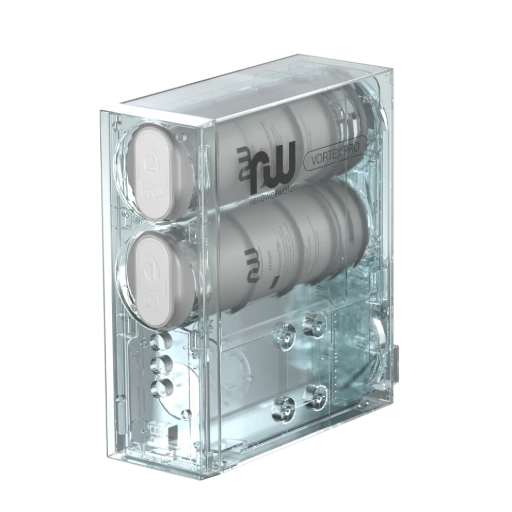
Fourth, the rejected water carries those substances to the drain. Some water always goes to waste. This is an important point to understand before you buy.
Fifth, the purified water goes straight to your tap. In a direct flow system, there is no storage tank.
Which contaminants does reverse osmosis remove?
Reverse osmosis is one of the most thorough home treatment methods for dissolved contaminants. It is commonly used to reduce:
- Dissolved salts and minerals, measured as total dissolved solids (TDS)
- Heavy metals such as lead and arsenic
- Nitrates from farming and groundwater
- Many PFAS compounds
- Some bacteria and viruses
It is not a complete answer for every concern. Reverse osmosis does not soften water. Hard water and limescale still need a separate softener. It also removes some useful minerals. Some organic compounds and dissolved gases are better handled by other types of filter.
Should I test my water before buying a reverse osmosis system?
Not every home has the same water. Your local supply, the age of your pipes and whether you use a private well all matter. Two homes a few streets apart can face different concerns.
The best first step is a clear picture of your own water. A test shows what is present. That result guides the right choice of filtration.
Which reverse osmosis system is right for my home?
For households concerned about drinking water, the ArkkZ Water Filtration System is a reverse osmosis option for direct flow. It uses one filter stage to remove sediment and other particles before the water reaches the membrane. The membrane then removes up to 99% of many dissolved contaminants, and the water flows straight to your tap.
Renewell Water is Ireland's Number 1 rated water filtration company. You can read what customers say at https://renewellwater.com/reviews.
If you would like to see how the ArkkZ could fit your kitchen, you can explore the system here.
Renewell Water offers a free consultation for you. Book it by clicking here.