

I remember the first time I switched from a jug filter to a proper Reverse Osmosis system. My kids had been getting through two or three jugs of filtered water a day, and I genuinely thought I was doing the right thing for them. Then I started looking more closely at what a jug filter actually removes from tap water — and how it removes it. That was the moment everything changed.
If you're sitting on the fence between a countertop jug filter and a Reverse Osmosis system, I want to walk you through what actually separates the two, because the difference is far greater than most people realise.

How Each System Actually Works
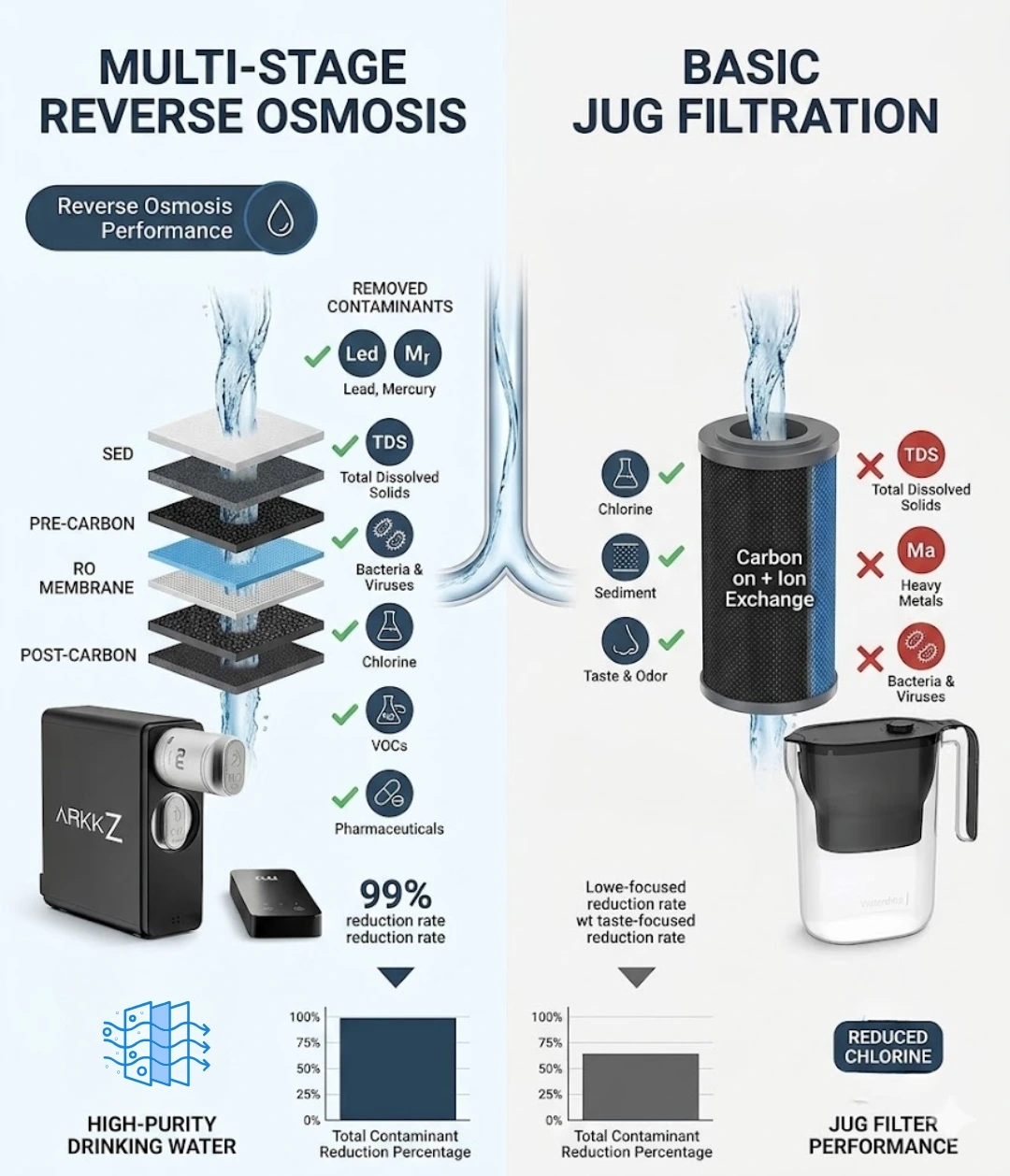
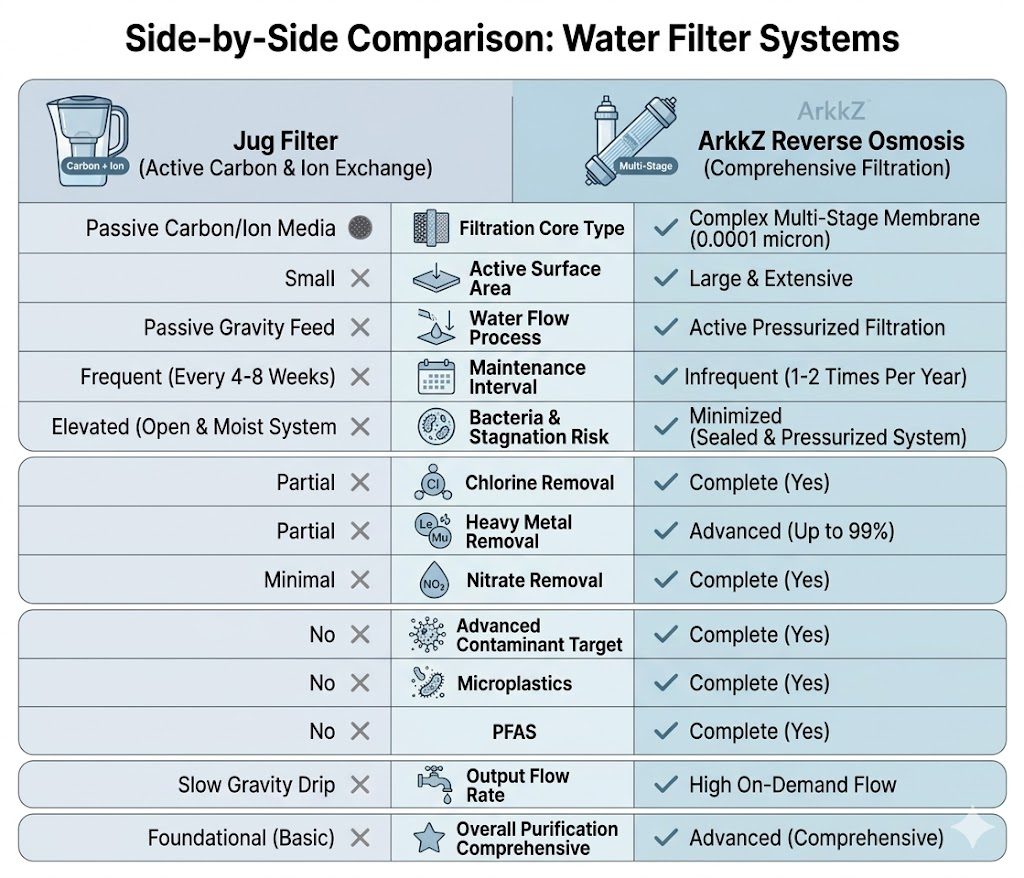
A jug filter works by passing water through a small carbon and ion-exchange resin cartridge. The water drips through gravity alone, which means it's slow and the contact time with the filter media is limited. Because the filtration surface is small — typically just a few square centimetres — and the method relies on basic adsorption, there's a ceiling to how much it can actually capture.
A Reverse Osmosis system (RO) is an entirely different technology. Water is pushed under pressure through a semi-permeable membrane with pores as small as 0.0001 microns. That membrane physically blocks contaminants at a molecular level — not just trapping particles but rejecting dissolved substances including heavy metals, nitrates, fluoride, pharmaceutical residues, microplastics and a wide range of other compounds that a jug filter simply cannot touch. Most modern RO systems like the ArkkZ also layer in pre-filters and post-filters — sediment, carbon and mineralisation stages — giving water multiple barriers to pass through before it ever reaches your glass.
The Filtration Surface: Size Matters More Than You Think
This is one of the most overlooked factors in the whole comparison. A typical jug filter cartridge has a filtration surface of just a few square centimetres. The ArkkZ RO system, by contrast, works with a membrane with a vastly larger effective surface area, combined with multi-stage filtration. Greater surface area means better contact, better capture rates and more consistent results over time.
Think of it like this. Pouring water through a kitchen sieve catches big lumps. Pouring it through a fine coffee filter catches far more. Pushing it through an RO membrane is the equivalent of catching things you cannot even see with the naked eye.
Maintenance and Bacteria Risk
Here is something I genuinely wish someone had told me sooner. A jug filter, if not changed frequently enough, can become a breeding ground for bacteria. Studies have shown that the moist environment inside a used filter cartridge can actually harbour more bacteria than the unfiltered tap water going in. Most manufacturers recommend changing the cartridge every 4 to 8 weeks, but research published in the journal npj Clean Water found that many households leave theirs in far longer... in some cases for months.
An RO system like the ArkkZ operates in a sealed, pressurised environment that is significantly less susceptible to bacterial colonisation. Maintenance is also far less frequent, filter changes are typically required once or twice a year, and the system alerts you when attention is needed. It's genuinely more hands-off, which as a parent managing a busy household, I found to be a serious quality-of-life improvement.
What Each System Actually Removes
This is where the real conversation lies.
A jug filter does a reasonable job on chlorine taste and odour, and can reduce some heavy metals like lead and copper to a degree. But it offers minimal protection against nitrates, fluoride, PFAS (so-called "forever chemicals"), pharmaceutical compounds, microplastics or dissolved salts.
Reverse Osmosis removes up to 99% of dissolved contaminants, including lead, arsenic, nitrates, fluoride, chlorine, chloramine, microplastics, pharmaceutical traces and a wide range of heavy metals. It's the technology used in bottled water plants and medical-grade water purification for a reason.
A Simple Comparison Table
So Which One Should You Choose?
If you are using a jug filter right now, I'm not going to tell you it's worthless. It's better than nothing, and it will take the edge off chlorine taste. But if you have children in the house, if you live in an area with hard water or high nitrate levels, or if you've ever read a Boil Water Notice and felt a knot in your stomach — a jug filter is not giving your family the protection they deserve.
Reverse Osmosis is the gold standard in home drinking water filtration. It's the technology that researchers, water quality experts and health professionals consistently point to when the conversation turns to genuinely clean drinking water.
The Best RO System in Ireland and the UK
When it comes to choosing the right system, you want a brand with real expertise, real track record and real customers behind it. Renewell Water has been installing water filtration systems in Irish and UK homes since 2002, helping over 20,000 families take control of their water quality. They are the Number 1 rated water filtration company in Ireland, and you can read what their customers say at renewellwater.com/reviews.
Their flagship drinking water solution, the ArkkZ Water Filtration System, is a compact, tankless Reverse Osmosis system that sits neatly under your sink and delivers unlimited, pure water on demand. No waiting for a jug to fill. No worrying about whether the cartridge is overdue. No compromising on what goes into your family's bodies.
As Simon Newell, founder of Renewell Water, puts it: "Buy the filter. Don't be the filter."
Your water should be doing the hard work. Not your body.
Have questions about which system is right for your home? Renewell Water's team of water filtration experts is always on hand to help you find the best solution for your water quality, your household and your budget.