
Everything You Need to Know...
You came looking for a straight answer about your well water. Good. That is exactly what this guide is for.
Owning a private well gives you a kind of independence most homes on the mains never have. It also hands you a job they never have to think about. Keeping that water safe is entirely down to you. Well water can carry a handful of things you would rather it did not, including bacteria such as E. coli, iron and manganese that stain and clog, lead, and nitrates. A few of them you might notice in the colour or the taste. The ones that matter most, you will not.
This guide zooms in on one of those invisible risks in particular, because it is the one most well owners have never thought to check, and the one Ireland's own water data keeps flagging. Nitrates.
Here is the thing nobody tells you. You could pour a glass right now, hold it up to the light, and it could look perfectly clear, smell fresh, and taste the way it always has. And it could still carry a level of nitrates that no parent would knowingly hand to their child.
That is the hard part about nitrates. They are invisible. No colour, no smell, no taste. The only way to know they are there is to test for them.
We talk to families across Ireland every week who assume their well water is grand because it has always seemed grand. We understand that completely. But "seems fine" and "tested safe" are two very different things, and when there are little ones in the house, the gap between them matters. So let's walk through what nitrates actually are, why wells are the supply most at risk, and the one simple step that reveals the full picture of what is in your water, nitrates and everything else included.
Renewell Water offers a free consultation for your well water. Book it by clicking here.
First, what makes a private well different
In Ireland, your water comes from one of two places. Most homes are on a public supply run by Uisce Éireann, or on a group water scheme. A smaller share of households, mainly in rural and farming areas, draw from their own private well. Roughly one in eight people in Ireland rely on a private well for their drinking water.
Here is the key difference. Public supplies and group schemes are monitored. They are tested regularly for bacteria and chemicals, and the results are reported and enforced by the EPA and local authorities. If something goes wrong, there is a system that catches it and a boil water notice that follows.
Private household wells sit outside all of that. They are the one supply type in Ireland that is not routinely monitored by anyone. The responsibility for testing, treating, and keeping that water safe rests entirely with the homeowner. Nobody is checking it for you. Nobody is going to ring you if your nitrates creep up.
That independence is part of the charm of having your own well. It is also the catch.
What nitrates are?
and how they get into your water?
Nitrates are a form of nitrogen. A little nitrogen in the environment is normal and necessary, it helps plants grow. The problem is excess.
The main source of excess nitrate in Irish water is agriculture. Chemical fertilisers and animal slurry are spread on land, and when more is applied than the soil and crops can take up, the surplus does not just disappear. It washes down through the soil, especially after heavy rain, and seeps into the groundwater below. Poorly maintained or badly placed septic systems can add to the load too.
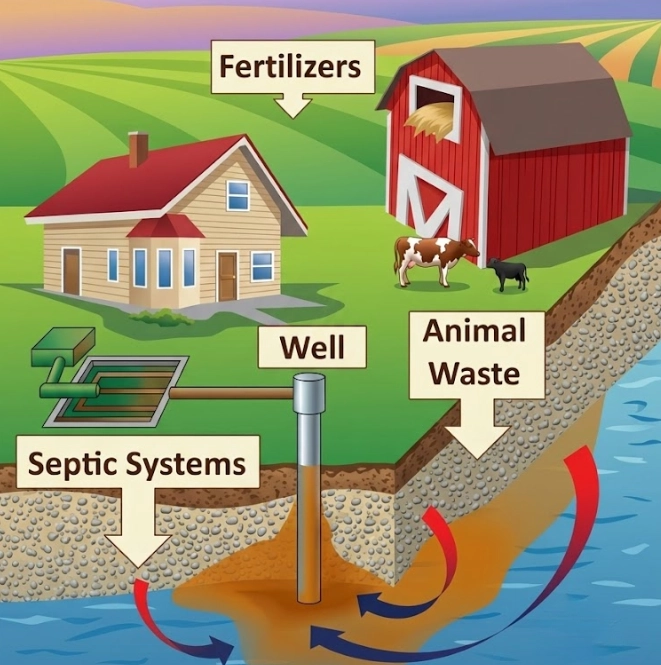
Your well draws from that same groundwater. So if your home sits in an area with intensive farming and free draining soils, there is a clear path for nitrates to travel from a field into your kitchen tap.
What the EPA's data tells us
The EPA's water quality monitoring for 2025 found no real improvement nationally. Nutrient levels, nitrates and phosphorus among them, remain too high in a large share of our water bodies, and the biggest source continues to be agriculture, with wastewater contributing as well.
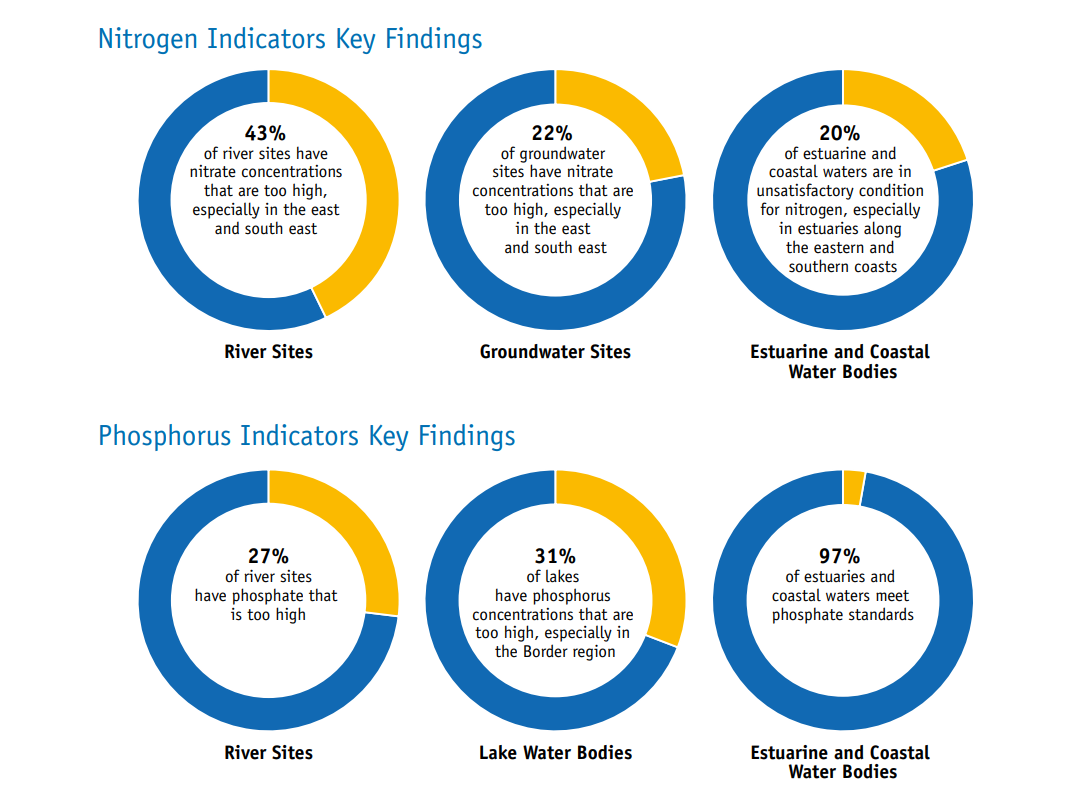
When it comes to groundwater specifically, the national picture is not uniform. Most groundwater performs reasonably against the drinking water standard, but a meaningful minority does not, and the pressure is concentrated in particular catchments in the south and southeast where farming is most intensive.
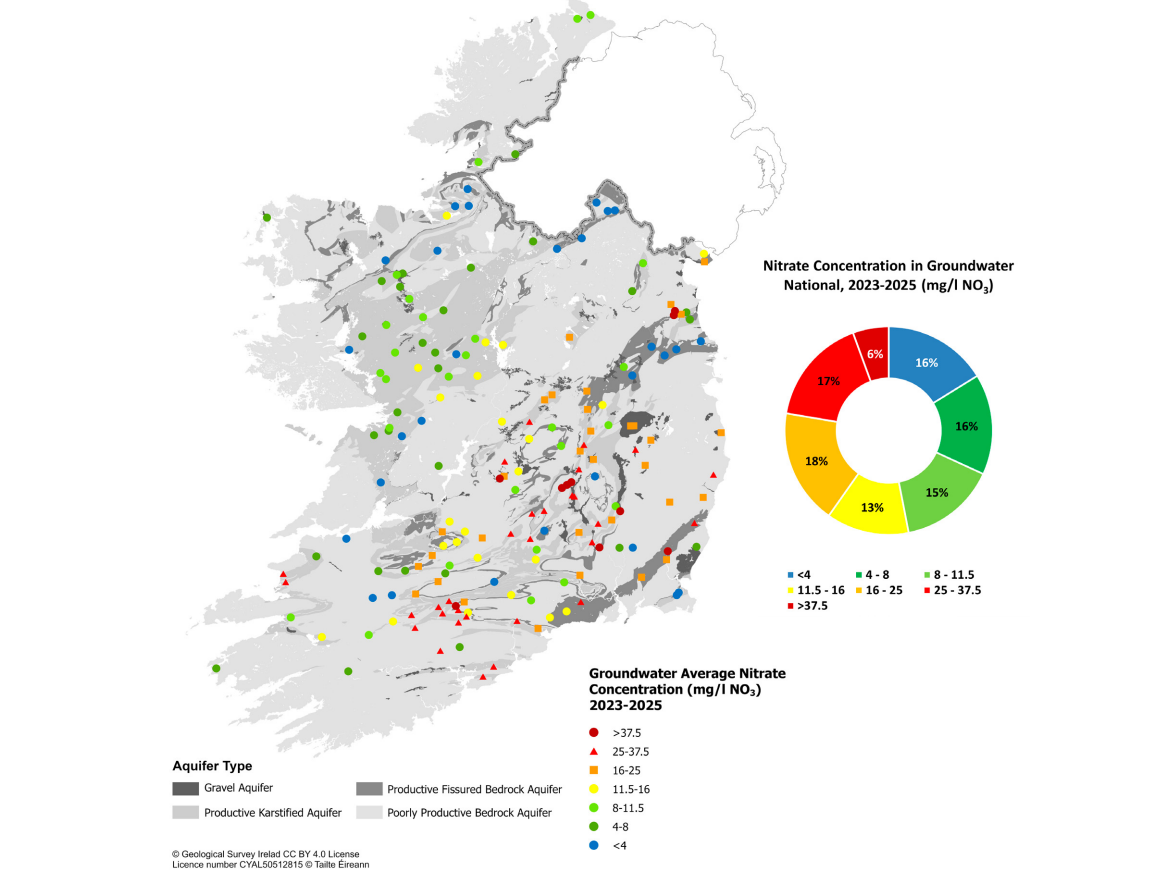
This is the part well owners need to hear clearly. The EPA monitors a national network of stations and the public supplies. It does not monitor your individual well. So while the national data is useful for understanding the trend and the risk in your region, it can never tell you what is actually coming out of your own tap. Two wells on the same road can give very different results depending on depth, soil, and what is happening on the land nearby.
Read the full report here.
Why this matters for health
Drinking water in Ireland has a legal nitrate limit of 50 mg/l. That limit exists for a reason, and it is set to protect the people most at risk.
The concern is greatest for infants. In babies under six months, high nitrate levels can interfere with the blood's ability to carry oxygen, a condition known as blue baby syndrome. It is rare, but it is serious, which is why formula should never be made up with well water that has not been confirmed safe. Pregnant and nursing mothers, and elderly or vulnerable family members, also sit in the higher risk group.
For most healthy adults, the occasional glass is not the worry. The worry is steady, long term exposure to water that quietly sits above the limit, in a home where nobody has thought to check.
The single most important thing a well owner can do
Test your water. Properly, and regularly.
Not a quick home dip strip, which can miss low level contaminants, but a full parameter test through an accredited laboratory. A proper test looks at nitrates, bacteria such as E. coli and coliforms, and the other contaminants that commonly turn up in Irish groundwater, including iron, manganese, and heavy metals. The EPA recommends testing private wells at least once a year, and sooner if anything changes, after flooding, after work on the well, or if you notice any shift in how the water looks, tastes, or smells.
If you are ready to take that step, have a read of Why Testing Your Well Water Is the One Thing You Should Never Skip. It walks you through the whole process from start to finish.
So here is what we would gently suggest if you are on a well:
- Test once a year, minimum. Treat it like a health check for your water.
- Use an accredited laboratory. The results need to be reliable enough to act on.
- Act on what you find. A clear result is peace of mind. A poor one is a problem you can now solve, instead of one you never knew you had.
Where Renewell Water fits in
We have spent more than twenty four years helping families across Ireland and Northern Ireland get control of their water, and we are proud to be the number one rated water company in the country. You can read what those families say for yourself over on our reviews page.
But we are not going to point you at a product today, because that would be putting step two before step one. Every well is different, and the right answer depends entirely on what your water actually contains.
If you are on a well and you are not sure where to start, book a free consultation with us. We will talk you through testing, help you make sense of the results, and only then have an honest conversation about whether you need a solution at all, and if so, which one genuinely suits your home.
Clean water should happen before it reaches your glass. Let's find out what is in yours first.